
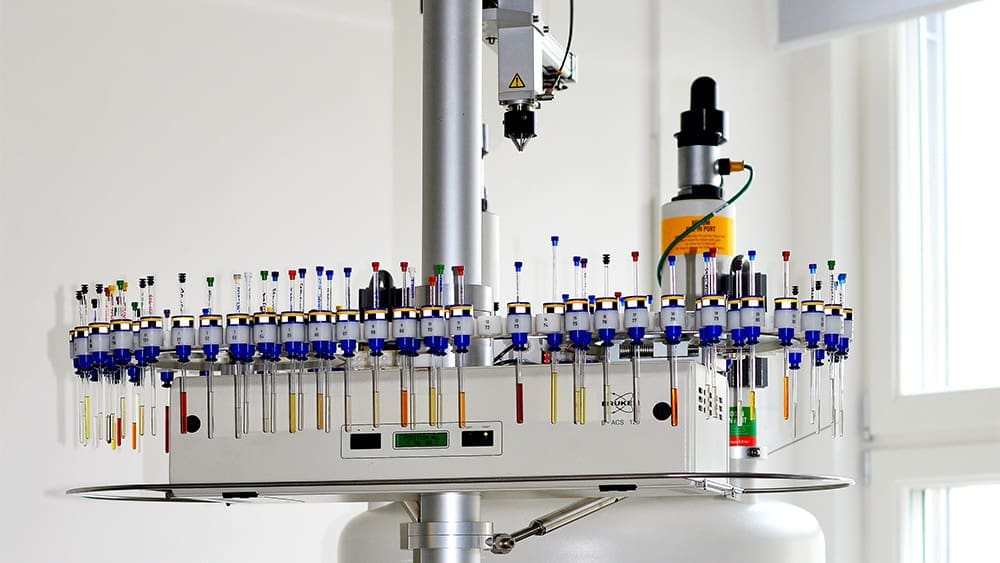
Nuclear magnetic resonance (NMR) spectroscopy is used to undertake chemical analysis of samples in the food and pharmaceuticals among other sectors. The technique uses radiofrequency pulses to excite atomic nuclei of dissolved samples that are placed inside a strong magnetic field, with the atoms having characteristic signatures that can be detected via the NMR instruments.
For pharmaceuticals, it is particularly useful for identifying impurities, and for studying drug-protein interactions. And in food it is used for quality control, detection of contaminants (such as sugar added to honey), and for authentication of, for example, wine, olive oil, cheese and other DOP produce.
Precise control of the RF signals is therefore vital and ADCs play a significant role in this task, delivering pulses from 5MHz to 1.3GHz to the filter.
Silanna has recently been working with one of the leading European manufacturers of these instruments to reduce its risks related to the ADC’s supply chain.
In its NMR instruments, the transceiver’s Tx function needs to send milliwatt level signals through an IQ digital upconverter / and mixer. While the Rx side uses a 16-bit 240-MHz data converter from one of the big two suppliers, coupled with FPGA to receive the feedback from the samples for spectral analysis.
Being a low-volume ADC customer, the company is left particularly vulnerable to supply chain issues when working with traditional ADC manufacturers, where each individual SKU requires its own costly manufacturing run. This in turn creates a significant risk for data converter manufacturers, preventing large (lower cost) production runs from being undertaken and so both increases costs and ensures long lead times. Crucially, it also prevents any long-term guarantees for availability being given, and it’s common for companies to end of life products with little-to-no warning. Given an NMR spectrometer design will last for 15-20 years, any chance of a component being end-of-lifed becomes a significant issue for those developing them. At the same time, performance cannot be compromised.
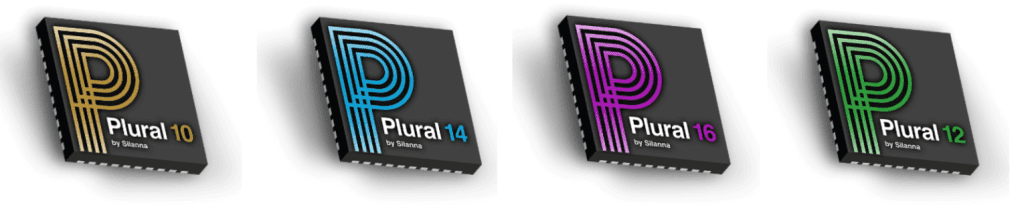
Silanna’s Plural ADCs
Silanna takes a different approach. Its Plural ADC platform implements a ResolutionEngine™ to factory configure specific SKUs from its 10-, 12-, 14- and 16-bit ADC base devices after manufacturing.
This increases the number of devices that can be stocked without the risk traditional manufacturing methods impose, which in turn increases the size of production runs, lowers the cost of manufacturing, allows stock to be held, reduces lead time and completely eliminates the need to ever end of life a product.
Devices offer single- and dual-channel options, CMOS and LVDS outputs, exceptional SFDR and SNR values, and a range of sample rates from 20 to 250 Msps. Additionally, MIL-TEMP variants are available, as is an integrated DSP option that undertakes many functions that an FPGA would typically be required for.
They are also available in a range of sizes and as direct drop-in-replacement components for many commonly used ADCs manufactured by the two duopoly suppliers.
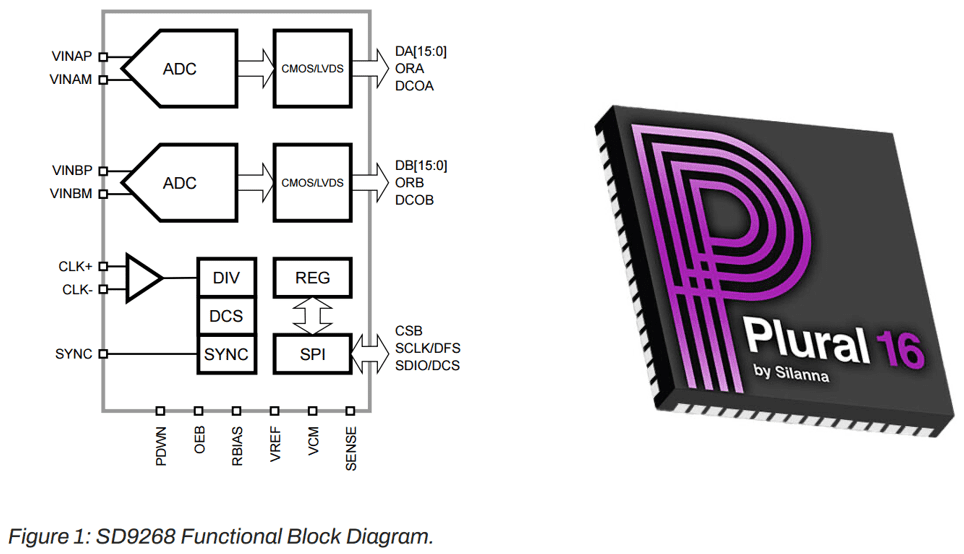
Silanna’s SD9268-125
While performance and supply chain management were the developer’s primary concerns, it was also vital that the replacement ADC have minimal effect on the design. Many of Silanna’s Plural ADCs have been designed to be perfect drop-in replacements for existing devices from ADI and TI. And this was possible here, with the selected ADC, the SD9268-125, matching not only the performance but also being pin-for-pin compatible with the legacy device.
This ADC minimized redesign and offered the required 16-bit, 125 Msps performance, with an SFDR of 88.23 dBc, and SNR of 75.52 dBFS (at 70.2 MHz) in a dual-channel 64-pin 9x9 mm chip.
And because of its unique design, Silanna was able to not on match the required specification, but to also deliver it faster and at a significantly lower cost than the legacy provider, with both technical support and supply chain guarantees.
As to future designs, feature rich variants, such as the 16-bit 170-Msps SD1150-170 with integrated DSP have also been put forward for the next iteration of the spectrometer, enabling its existing spectral analysis FPGA to be eliminated and the design further simplified.
Find out more
If you’d like to find out more on how Silanna’s Plural ADC platform can help you reduce your dependency on a single supplier and take back control of your supply chain, please tell us about your challenges here.