
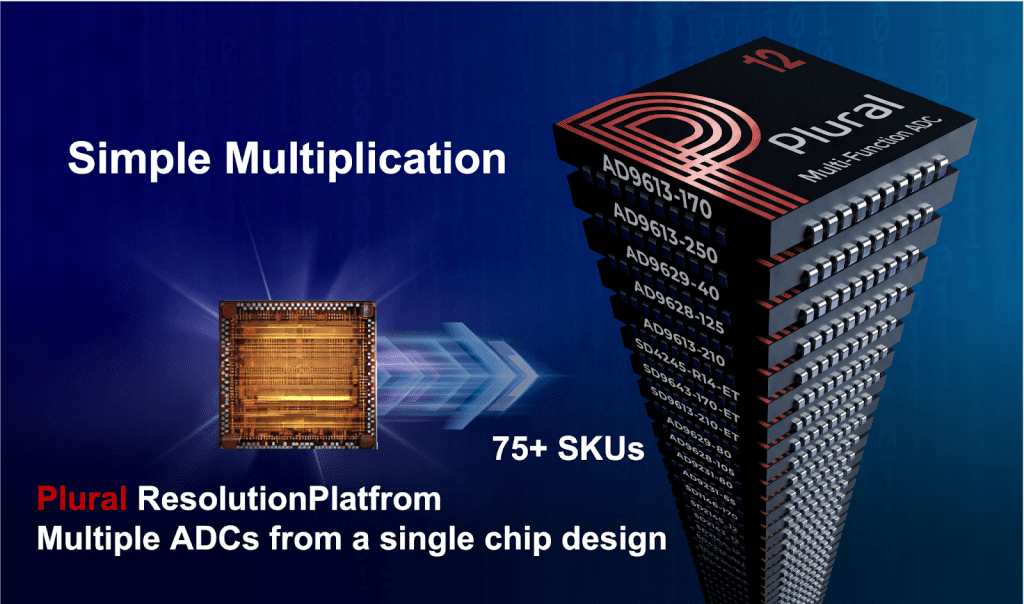
Within the last year, Silanna announced a new patented analog-to-digital converter (ADC) platform known as Plural. This architecture takes a completely different approach to traditional models, with configurations set not in hardware, but in the factory after fabrication is complete.
Taking this approach has enabled the creation of a wide product portfolio but without the cost burdens that would normally come with having such a wide product offering. Indeed, the economies of scale offered by the Plural approach to ADC SKU portfolios allows us to share this benefit with our customers, with costs cut by 30% versus legacy data converter vendors. Furthermore, because each SKU is based on the same base design and only set after manufacturing, it also removes the huge risk that legacy manufacturers face, and so Silanna can ship faster and guarantee future supply chain reliability.
In this blog, we’ll discuss how this is achieved and the benefits Plural provides to customers.
Why Traditional ADC Portfolios Are Expensive and Fragile
The economics of the ADC market make broad product offerings difficult to support. Each unique ADC configuration traditionally requires its own wafer stack, validation effort, and inventory commitment. Every additional resolution, sampling rate, package, or temperature grade increases development cost, qualification effort, and inventory risk.
As portfolios expand, these costs grow nonlinearly. For vendors, carrying inventory across hundreds of SKUs comes with a huge risk and quickly becomes cost prohibitive, especially when demand is uneven or unpredictable.
To manage this complexity, legacy ADC vendors typically stock only their highest-volume products, with long and uncertain lead times (and often higher prices) for anything that can even remotely be described as niche. Over time, these pressures have driven widespread consolidation within the ADC industry and established names such as National, Linear, and Maxim have been acquired by Analog Devices and Texas Instruments, leaving what is, in effect, a duopoly.
For system designers, this consolidation has limited supplier choice, increased prices, created long lead times, and made end-of-life announcements a common occurrence. When an ADC is discontinued, redesigning a system is often expensive, time-consuming, and risky, particularly in industrial, communication, and defense applications where product lifecycles can span decades.
Factory-Configurable ADC Platforms
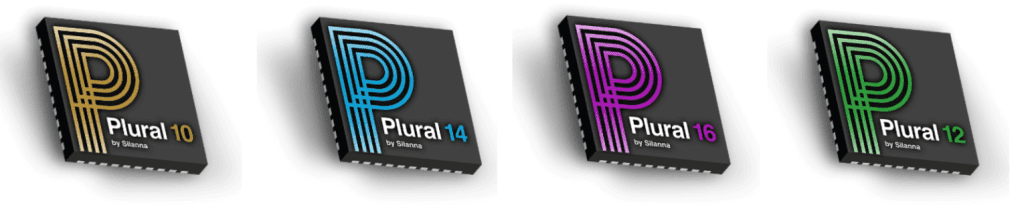
Plural was developed to break this cycle. Instead of creating hundreds of fixed-function devices, Plural is built around a small number of base ADC designs that are configured after fabrication. The platform currently consists of four base architectures covering 10-, 12-, 14-, and 16-bit resolution ADCs.
It has been implemented on a fully qualified TSMC 40 nm CMOS process, chosen for its maturity, reliability, and long-term availability. Initial products were developed as pin-for-pin drop-in compatible replacements for widely used legacy ADC configurations, allowing customers to switch devices without modifying PCB layouts, firmware, or system timing.
As such, Plural ADCs are designed to function identically to traditional ADCs from a system integration perspective. But by using Silanna’s proprietary ResolutionEngine™, key device parameters are programmed ahead of shipping, rather than being permanently defined in silicon.
This allows a single wafer design to support many different end-product configurations, including a wide range of sampling rates - currently from 20 to 250 Msps, with ensured signal integrity even at high sampling rates: SFDR = 89.45 dBc in high-precision configurations and 76.20 dBc at 250 Msps.
The result is a flexible four-platform architecture that is capable of serving demanding industrial and communications applications without the traditional cost penalties associated with broad SKU portfolios.
Because only a small number of base designs are fabricated, Silanna can build and hold significant inventory (in excess of 700,000 devices per platform) without the financial risk typically associated with broad ADC portfolios. This not only brings economies of scale, it eliminates the economic incentive to discontinue individual products, and enables shipping for even the most niche of configurations within weeks of order placement.
Finally, all Plural ADC architectures and associated intellectual property are developed in the United States, with manufacturing performed offshore in locations entirely outside of China. This allows competitive pricing while reducing geopolitical and supply-chain risk.
Portfolio Expansion and Roadmap Flexibility
Because the platform is factory-configurable, the roadmap can be adjusted based on real customer demand rather than long-term forecasts.
To date, the range has expanded rapidly. In October 2025, the Plural platform included 50 ADC configurations. At time of writing (February 2026) this has expanded to more than 80, including single- and dual-channel devices in both 32-pin (5 × 5 mm) and 64-pin (9 × 9 mm) packages. All current and future Plural ADCs are priced to be approximately 30% lower than comparable offerings from legacy suppliers, who have recently increased pricing across their portfolios.
The platform has already expanded in terms of functionality and performance too. ADCs are now available with an integrated DSP to enable functions such as on-chip decimation, IQ pairing, and interleaving with decimation, real and complex, etc. These capabilities allow functionality to be moved from FPGA logic into on-chip ASIC-level implementations, reducing system power and complexity. MIL-TEMP variants are also now available, which support operation from –55 °C to +125 °C.
Silanna’s roadmap includes additional 4- and 8-channel ADCs, DACs, and transceiver products, with future sampling rates set to reach 4 Gsps. Serialized LVDS and JESD204B interfaces are also set to be added to support higher data rates and system-level synchronization.
Conclusion: Why Factory-Configurable ADCs Matter
The economics for traditional ADC fabrication are broken and benefit no one. They certainly don’t benefit the customer, it is even questionable, given the risks involved, if they benefit the manufacturer.
By consolidating a wide range of products around a small number of base silicon designs, Silanna’s patented factory-configurable approach enables lower costs, shorter lead times, and long-term availability without compromising performance or compatibility.
For system designers, this means access to a broad range of high-performance ADCs that are pin-compatible with industry-standard devices, available in weeks rather than months, and protected from end-of-life risk. In a market defined by rising prices, consolidation and constraint, factory-configurable ADC platforms offer a scalable and resilient alternative.
Further information on Plural ADCs, including datasheets and pricing, is available via the 10-, 12-, 14-, and 16-bit pages of the Silanna ADC website, or visit our FAQ.