

Ultrasonic flow measurement is a non-invasive technique that uses time-of-flight and Doppler-based soundwave sensing to determine the speed of travel for a liquid or gas through a pipe. It is used across a wide range of sectors for industrial flow control, including in gas pipelines, water infrastructure, manufacturing and process control, and is implemented via sensors clamped onto the outside of the pipe rather than an in-pipe flow meter.
This gives several benefits as sensors can be retrofitted to pipes and easily replaced without cutting into plumbing or stopping production. It also reduces degradation of the sensor itself (especially in wastewater, mining slurry, and chemical manufacturing applications) and prevents additional sources of potential contamination (in food production and pharmaceuticals).
ADCs naturally play a vital role in translating the information from the transducers to calculate changes in timing and frequency shift, and any integrated ADC requires high performance, accuracy and reliability. But with the specified devices used in such systems being relatively niche and low-volume, supply chains can be put at risk from the underlying economics of ADC manufacturing. In traditional approaches, each individual SKU requires its own costly manufacturing run, which increases risk, increases costs, and so limits the number of suppliers, and any long-term guarantees for availability.
This manufacturing model, and the risk it imposes, has also led to a wave of consolidation within the industry and what is effectively an ADC duopoly that forces a dependency on incumbent suppliers.
The Challenge
This was certainly the case for a Silanna customer, who in 2025 approached us, needing an alternative to a high-priced legacy ADC that was facing (at best) supply uncertainty, and at worst, an end of life.
The requirements were … straightforward. High-accuracy signal capture was essential. Redesign must be kept to an absolute minimum. Long-term supply reliability must be in place. And costs must be kept to a minimum.

Silanna’s Plural ADCs
Unlike other ADC manufacturers, the Silanna Plural platform is factory configurable via the company’s ResolutionEngine™. It starts with a baseline device for its 10-, 12-, 14- and 16-bit ADCs, with these being configured to specific SKUs after manufacturing is completed.
This brings several economic and supply-chain benefits, notably in terms of risk. Long production runs can be undertaken, and large quantities can be held even without a specific customer for them. Niche ADCs hold the same low risk as commodity devices, meaning there is never a need to discontinue a specific SKU, and (without needing to wait on a fab to give availability) lead times drop from months to weeks. And greater economies of scale can be accessed.
Devices offer single- and dual-channel options, CMOS and LVDS outputs, exceptional SFDR and SNR values, and a range of sample rates from 20 to 250 Msps. Additionally, MIL-TEMP variants are available, as is an integrated DSP option that undertakes many functions that an FPGA would typically be required for.
These devices are available in a range of sizes and as direct drop-in-replacement components for many commonly used ADCs manufactured by the two duopoly suppliers.
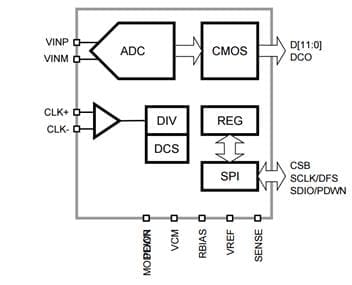
Silanna’s SD9629-40
In this case, Silanna was able to offer a high-performance alternative, the SD9629-40, that was a drop-in replacement for the legacy device. This minimized redesign and offers the required 12-bit, 40 Msps performance, with an SFDR of 86.70 dBc, and SNR of 71.87 dBFS (at 70.2 MHz) in a single-channel 32-pin 5x5 mm chip.
It was able to not only offer the required specification, but to also deliver it faster and at a significantly lower cost than the legacy provider, and to do so with technical support and supply chain guarantees.
Find out more If you’d like to find out more on how Silanna’s Plural ADC platform can help you reduce your dependency on a single supplier and take back control of your supply chain, please tell us about your challenges here.