
While LiDAR is increasingly recognized for its remote sensing role in autonomous vehicles and beyond, its broader adoption is often hindered by the power, size, and cost limitations of current laser driver systems.
Its implementation requires both high peak power and extremely short pulse widths to enable the accurate distance measurements required, but traditional discrete driver architectures often suffer from poor efficiency and thermal issues – which limits its usage and reduces the laser drivers’ lifecycle. These issues are amplified in smaller, low power battery applications like handheld rangefinders.
It doesn’t have to be that way and in this blog post, we’ll outline a new laser driver architecture – implemented in Silanna’s FirePower Laser Driver ICs for high-power LiDAR and rangefinder applications – that overcomes many of the limitations suffered by traditional systems and discuss what can be achieved through this technology.
Uses of LiDAR
LiDAR (light detection and ranging) is an active remote sensing technology for determining ranges (variable distances) by targeting an object or a surface with a laser and measuring the time for the reflected light to return to the receiver. This generates detailed point cloud data enabling the creation of precise three-dimensional models and maps of objects and environments. These high-resolution spatial measurements are used in applications across autonomous vehicles, robotics, and mapping.
Awareness of LiDAR has grown significantly in recent years, due in no small part to its use in autonomous vehicles and ADAS (advanced driver assistance systems) technologies, like adaptive cruise control and automatic emergency braking. Especially when combined with other sensing technologies, such as cameras and radar, LiDAR can help enhance safety by enabling a robust, reliable perception system across diverse lighting and weather conditions.
LiDAR-based solutions are also used across mapping and surveying applications in archaeology, environmental monitoring (including forestry, agriculture, and marine), and infrastructure inspection (of power lines, highways and railways, and bridges). Such LiDAR scanners may be mounted on vehicles, drones, or UAVs. LiDAR also excels at positioning mobile robots with impressive accuracy inside buildings where satellite navigation (GNSS) doesn’t work well.
LiDAR and laser-based time of flight systems have also started making their way into other consumer applications, for example smartphone cameras (for use in low-light autofocus, augmented reality, and rapid measurement) and handheld rangefinders used in outdoor sports such as golf.
Challenges for legacy laser driver architectures
However, the nature of the technology used to power LiDAR systems – primarily the laser drivers – means that many solutions currently on the market tend to be bulkier and more power intensive than is ideal. High performance LiDAR systems also tend to be expensive, so even within automotive, the cost, power consumption, and size of LiDAR modules continue to limit adoption.
Depending on the application, a LiDAR sensor may need to measure distances up to several hundred meters, which can require optical power of 100-200 W. Since the efficiency of laser diodes can typically be as low as 20-30%, the peak driving power delivered to the laser must be around 1 kW – making thermal management an additional challenge.
On the other hand, pulse duration must be short to ensure accuracy and adequate resolution, particularly for objects at close distances. In addition, since the peak optical power is high, limiting the pulse duration is critical to ensure the total energy conforms to health guidelines for eye safety. Fulfilling all these requirements typically calls for pulses of 5 ns or less.
In smaller equipment types, such as handheld rangefinders, the high voltage must be derived from a small battery of low nominal voltage – typically a 3 V CR2 lithium or 3.7 V lithium-ion battery. Doing so will often require multiple boost stages and, even if these are efficient in isolation, losses are compounded (so a two-stage process using 80%-efficient boost converters results in an efficiency of 64%). Added to this, the circuitry required to isolate high-voltage components is also inefficient, with some designs losing as much as 50% of the energy during the transfer process. At the same time, high overall efficiency is essential to maximize battery life while ensuring the high optical power needed for long range and high accuracy.
There are also several stages where energy is also lost as heat, notably during the MOSFET switching, through the internal resistance of the capacitor, and across the PCB traces. Thermal management techniques are therefore required to maximize the performance and lifespan of the laser diode and other sensitive electronics, with heatsinks adding to the size, weight, and cost of the overall system. And stringent constraints on enclosure size and the devices being sealed to prevent dust or water ingress make such thermal management more difficult, due to lack of airflow.
Overcoming the known power and size limitations in LiDAR design is critical to enabling scalable, cost-effective adoption across markets. If this can be achieved, there is also potential to develop new LiDAR application sectors, such as traffic, blind spot, or proximity alerts for bicycles.
A more efficient architecture
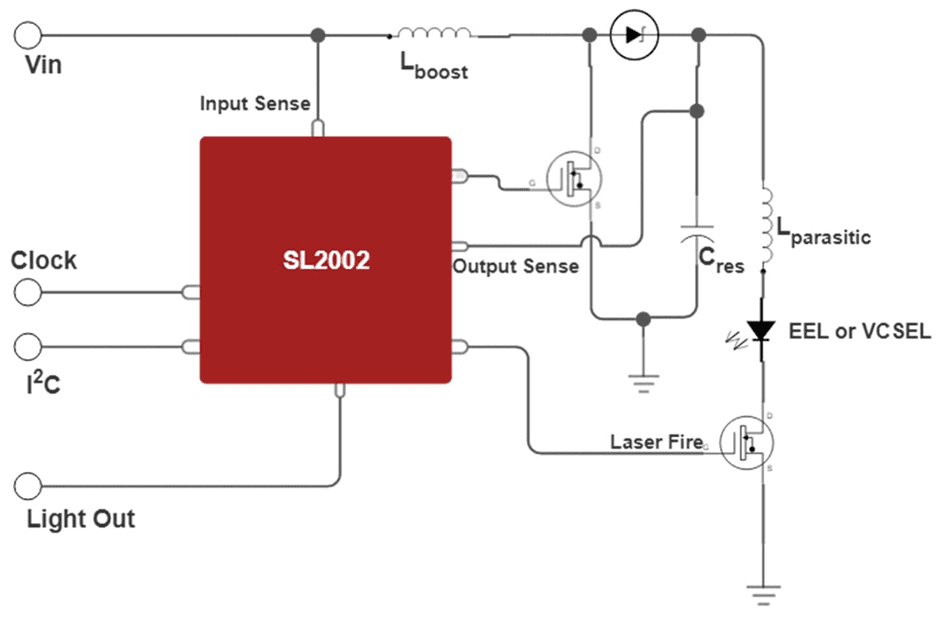
Rather than relying on a disparate collection of discrete components, which creates the aforementioned inefficiencies, it is now possible to combine the boost voltage regulator, a high-speed GaN FET driver, and the essential control logic onto a single chip.
Silanna’s FirePower is the first high-performance laser driver design to integrate both power and firing functions into a single 3.5 x 1 mm chip, freeing up board space while delivering the performance and cost savings to accelerate future laser and LiDAR innovation.
This high level of integration allows the driver to bypass the inefficient energy transfer inherent in discrete designs. Adopting this approach also enables the use of on-chip logic to directly manage the charging and firing of the laser to providing precise control over the pulse – be it from a vertical cavity surface or edge emitting laser (VCSEL/EEL).
As a result, an integrated architecture enables increases in peak optical power. So, whereas a standard consumer rangefinder would typically operate at between 5 W and 40 W, the SL2001 can deliver a peak power of up to 1000 W, and laser light power of 400 for 2 ns pulses, giving higher reliability and greater effective measurement range.
For rangefinder applications, which need to work from a 2.8V-5.5 V battery, Silanna’s SL2002 is able to provide a peak power of up to 200 W and pulse width up to 100 ns while retaining the improvements in efficiency, system size and BOM costs.
Such high peak power and energy pulses generates a stronger return signal, which is critical for ranging on distant or low-reflectivity targets, like a flagstick against a tree line. This results in a greater effective range and more consistent measurements in challenging conditions. The improvement in efficiency is also dramatic, with overall charging efficiency reaching 85%. This extends battery life and, because the system generates far less waste heat, eliminates the need for bulky heatsinks. The combined effect is a compact device with enhanced accuracy and a longer, more reliable operating range.
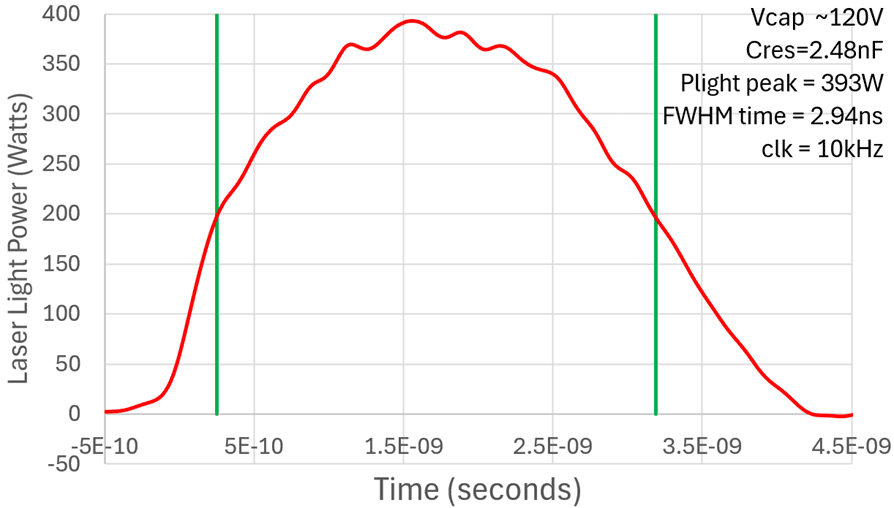
Figure 3: A laser light power curve for the SL2001
Conclusion
The transition from discrete components to an integrated, single-chip driver that delivers high optical output power with tightly controlled, nanosecond pulse width is the critical factor in resolving the efficiency and size constraints of portable rangefinders, be they for golf, photography, or new classes of devices such as cycling cameras with proximity alerts.
This architectural shift directly translates to longer battery life, more compact designs, and more reliable distance readings. This allows for enhanced performance in smaller devices. And through this change, advanced LiDAR sensing becomes viable across a far wider range of rangefinder applications.